TS Second Opinion
Check, repair and triage machine-learned transition-state guesses before you spend DFT.
About one in six GoFlow guesses has a stereocentre the wrong way round, and most of those are perfect mirror images that pass
distance scores, chirality-blind RMSD and even a DFT frequency check. This page shows real results; the tool runs on any
generator's output, with any elements, and installed on your computer all it needs is three .xyz files.
1 · Five real cases
Each case is GoFlow's real prediction (8 models) for an RDB7 test reaction, checked by TS Second Opinion. Drag a molecule to rotate it; the two views move together.
Why
Claude's explanation
Generated in advance with the Claude Code CLI from the facts above.
Stereocentres and every rule
2 · Check your own reaction
Any TS generator, any elements. Installed on your computer, all you need is the
reactant, the product and your TS guesses as .xyz files: bonds and stereocentres are read from the geometries,
which gives the same verdict as the dataset's own SMILES for 99.7% of the 1,194 test reactions. One command, no GPU:
pip install git+https://github.com/tammy357/ts-second-opinion
tsso check --reactant r.xyz --product p.xyz guesses.xyz --report report.html
tsso batch my_reactions/ --out tsso_batch # many reactions into one verdict tableThe live app is a marimo notebook running in your browser with Pyodide: nothing to install, and your files never leave your computer. The first load takes a little while, as Python starts in your browser, and there the atom-mapped SMILES is still needed.
Agents can use it too: tsso mcp-config prints the settings for Claude Desktop or Cursor,
tsso skill --install adds an agent skill to Claude Code, and the MCP tools take one reaction or a whole folder.
Was a verdict right? Every result links to a pre-filled GitHub form; it shares the verdict, never your structures.
3 · Rule Studio: plain English in, tested code out
A chemist writes a rule as a sentence. Claude writes the Python, and the gate keeps it only if it accepts at least 99% of 9,540 real DFT transition states, never crashes, and catches at least 1% of mirrored or distorted ones. Otherwise Claude gets the failures back and rewrites it. Two real runs:
4 · How much can you trust?
Conformal selection picks which reactions to trust so that, on average, at most the chosen share of them are wrong. Calibrated on half of the 1,194 test reactions and tested on the other half, 2,000 times.
5 · Stereo-aware leaderboard
"Success" usually means D-MAE ≤ 0.2 Å, which cannot see handedness. The last column counts only guesses that are close and correctly handed. Handedness stays at 82–85% correct for every released GoFlow model size.
6 · Results
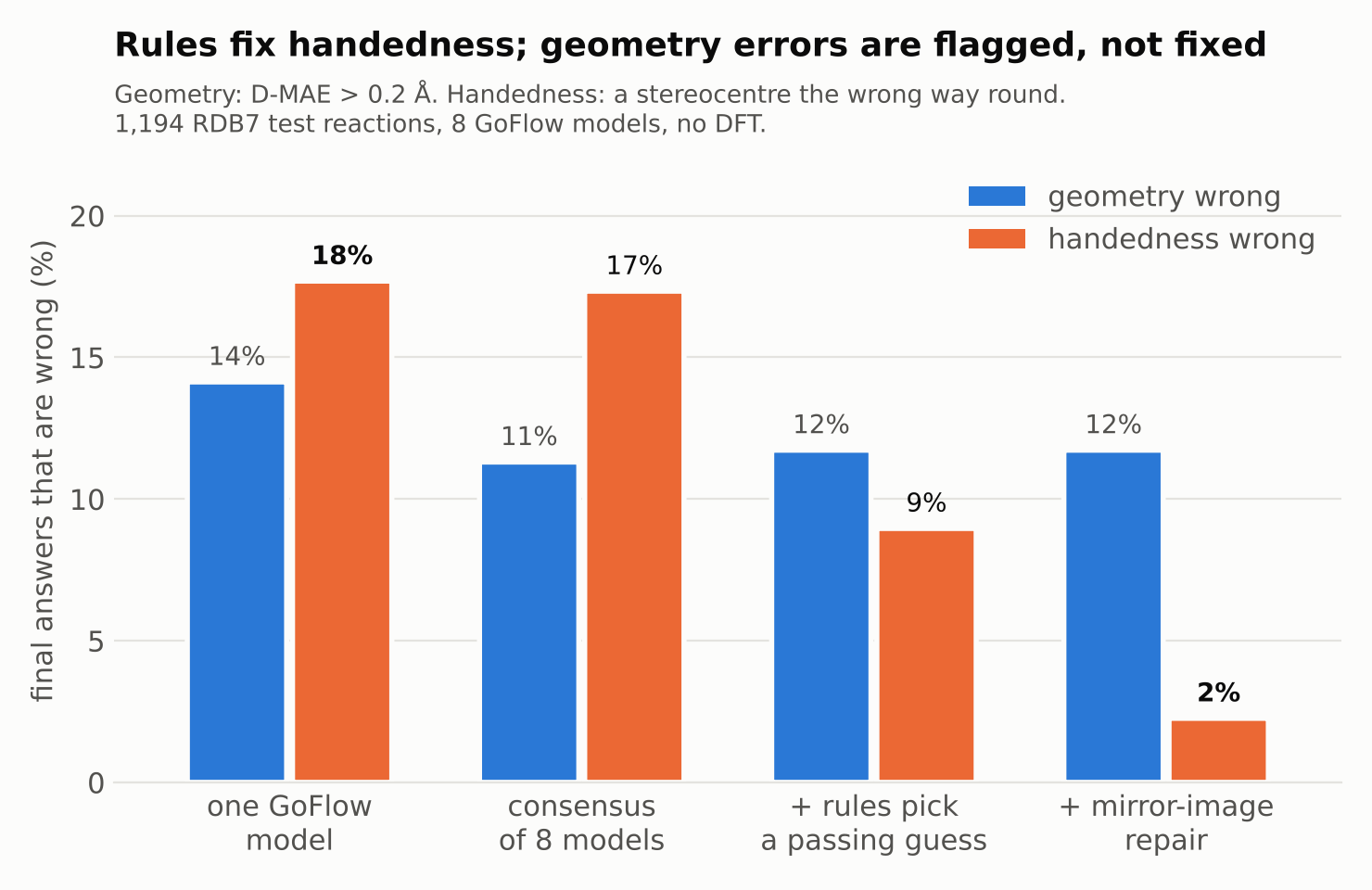
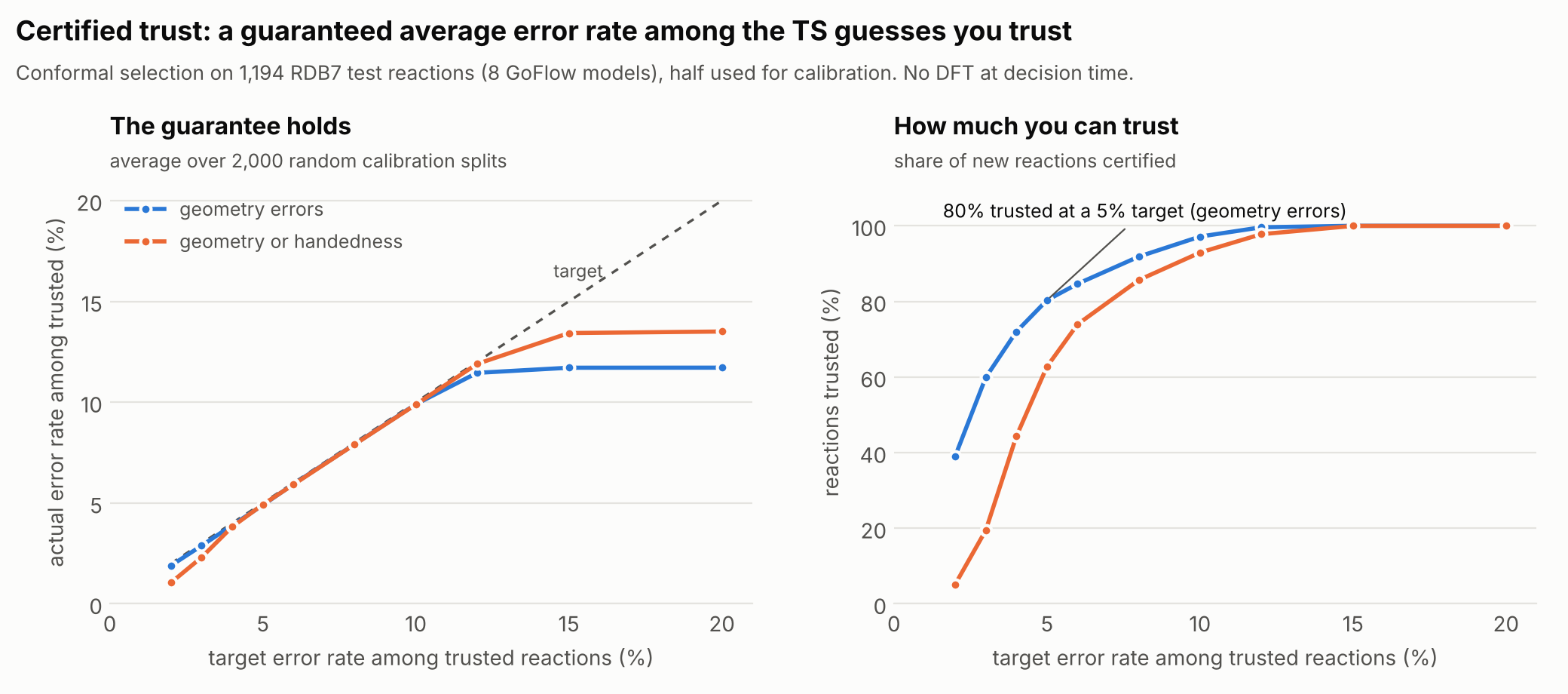
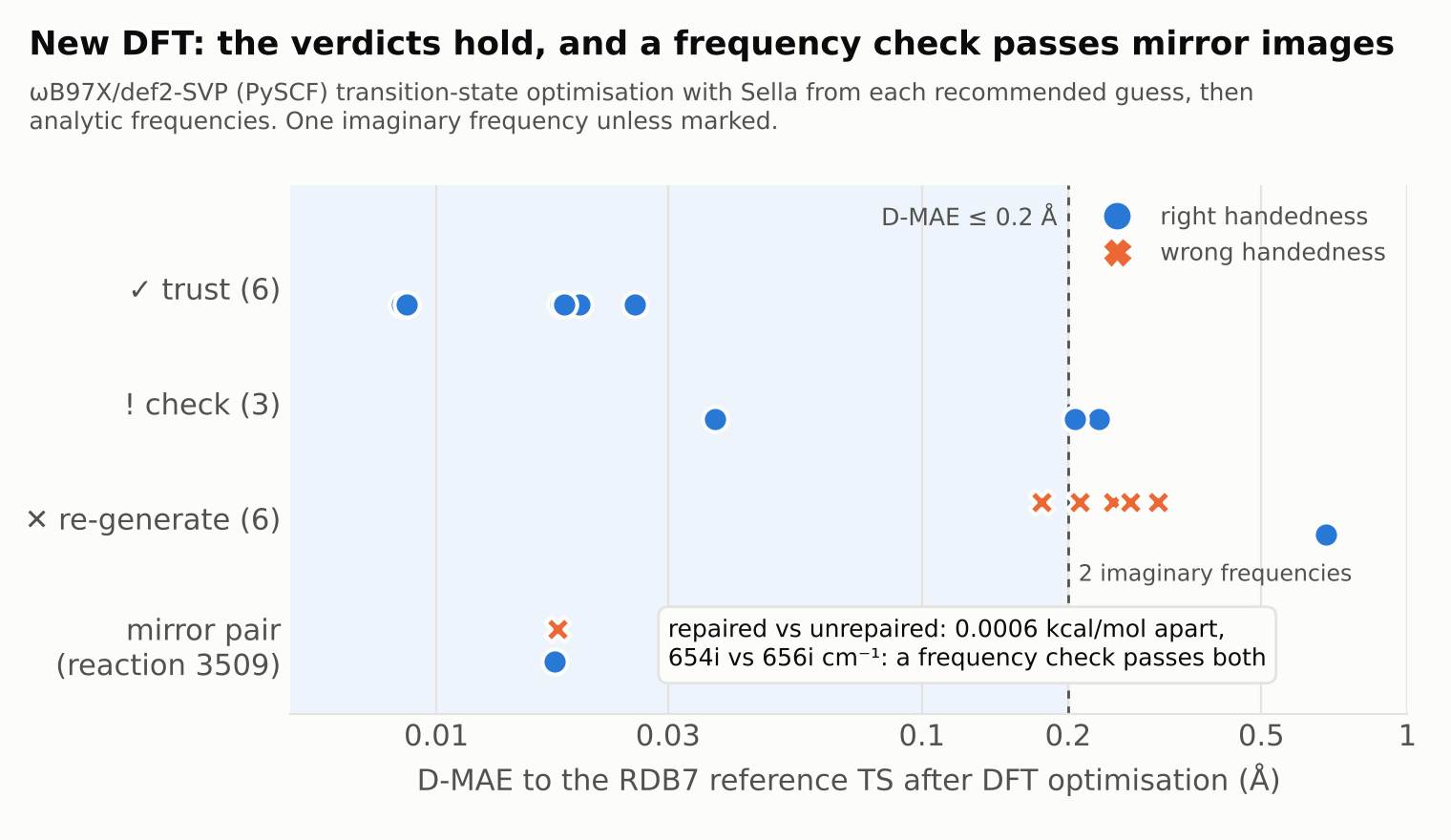
Mostly retrospective: GoFlow's released predictions for the 1,194 RDB7 test reactions; rules gated only on the 9,540 training reactions. New calculations test the verdicts: DFT (ωB97X/def2-SVP) transition-state optimisations on a small sample (every trusted guess reached the reference TS, no re-generate guess did, and a mirror image passed the DFT frequency check), and GFN2-xTB on 106 reactions (the right TS is reached for 77% of trusted guesses and 0% of re-generate ones). FK-Flow (from the GoFlow group) first measured GoFlow's chirality errors and fixed them by steering generation; TS Second Opinion works afterwards, on any model's output. Full results and limitations: docs/RESULTS.md.